Publications

Papers

Summary of peer-reviewed journal articles on the large-scale structure, galaxy statistics and the 21-cm signal, plus collaboration papers, newest first.

Showing all 11 papers.

2026

21-cm cosmology

The Epoch of Reionization 21 cm Bispectrum at z = 8.2 from MWA Data. II. Smooth Component Filtering

Sukhdeep Singh Gill, Khandakar Md Asif Elahi, Somnath Bharadwaj, Shiv K. Sethi, Akash Kumar Patwa

The Astrophysical Journal 1003, 189 (2026)

What it delivers. Adds smooth component filtering (SCF) to our MWA analysis at z = 8.2. Filtering out the spectrally smooth foregrounds lowers the cylindrical bispectrum by three to four orders of magnitude and also removes the artefacts left by missing frequency channels. In the cleaner EoR window (k⊥ ≤ 0.026 Mpc−1, k∥ > 0.135 Mpc−1), the tightest limits are −(1.25 × 10⁴ mK)3 ≤ Δ3 ≤ (1.22 × 10⁴ mK)3 at k1 = 0.281 Mpc−1.

Why it matters. What remains is consistent with thermal noise rather than foreground leakage. That changes the problem: longer observations should now tighten the limits directly.
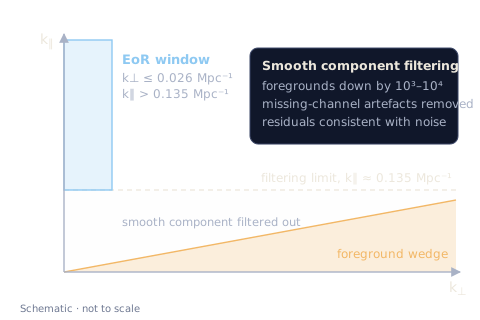
Schematic of the k-perpendicular, k-parallel plane: a foreground wedge at large k-perpendicular and low k-parallel, a band below the filtering limit where the smooth component is removed, and a narrow EoR window at small k-perpendicular above it.
SchematicFiltering removes the smooth component at low k∥. The measurement uses the clean window at small k⊥, above the filtering limit.

2025

Theory & methods

Probing Gravity beyond General Relativity with Bispectrum Multipoles of Cosmological Tracers: I. Theoretical Foundations

Sukhdeep Singh Gill

Publications of the Astronomical Society of Australia 42, e116 (2025)

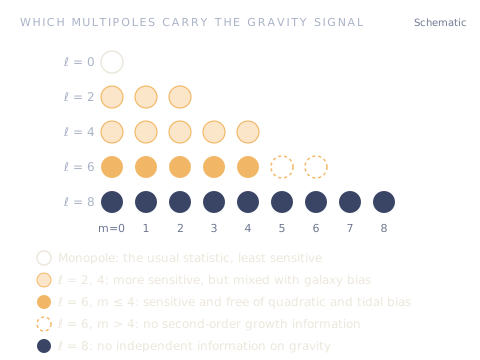
What it delivers. Develops the theory for testing gravity with the full set of redshift-space bispectrum multipoles, Bmℓ, taking degenerate higher-order scalar-tensor (DHOST) theories as the alternative to general relativity. It maps how each multipole and each triangle shape responds to changes in the second-order growth of structure.

Why it matters. The higher multipoles (ℓ = 2, 4, 6) are more sensitive than the monopole, acute triangles respond most, and several multipoles change sign when gravity departs from general relativity, a clear signature to look for. The ℓ = 6, m ≤ 4 multipoles are untouched by quadratic and tidal galaxy bias, which makes them especially robust probes.

Grid of bispectrum multipoles by l and m. The monopole is the baseline; l equals 2 and 4 are more sensitive but mixed with galaxy bias; l equals 6 with m up to 4 are sensitive and bias-free; l equals 6 with m of 5 or 6 carry no second-order growth information; all l equals 8 multipoles carry no independent gravity information.
SchematicThe paper's conclusions at a glance: which multipoles carry the signal of modified gravity, and which are robust to galaxy bias.

21-cm cosmology

The Epoch of Reionization 21 cm Bispectrum at z = 8.2 from MWA Data. I. Foregrounds and Preliminary Upper Limits

Sukhdeep Singh Gill, Somnath Bharadwaj, Khandakar Md Asif Elahi, Shiv K. Sethi, Akash Kumar Patwa

The Astrophysical Journal 993, 56 (2025)

What it delivers. The first attempt to measure the 21-cm bispectrum of the Epoch of Reionization in real data, from MWA observations at 154.2 MHz (z = 8.2). Foregrounds form a wedge in the cylindrical bispectrum, as they do in the power spectrum, but its shape is more complex because it depends on all three sides of the triangle. Outside the wedge, the best 2σ upper limits are Δ3 ≤ (1.81 × 10³ mK)3 for equilateral triangles at k1 = 0.008 Mpc−1 and Δ3 ≤ (2.04 × 10³ mK)3 for squeezed triangles at k1 = 0.012 Mpc−1.

Why it matters. It establishes the method and identifies the obstacles later analyses must overcome: the more complex bispectrum wedge, and spikes caused by periodically missing frequency channels. The limits still sit about seven orders of magnitude in Δ3 above the expected signal.

MWA z = 8.2: upper limits on the 21-cm bispectrum Two-sigma upper limits on the cube-root bispectrum amplitude, in millikelvin, against triangle size k1 for equilateral and squeezed triangles. The best limit is 1.81 thousand millikelvin for equilateral triangles at k1 = 0.008 per megaparsec, about seven orders of magnitude in Delta cubed above the expected signal of about ten millikelvin. 1 10 10² 10³ 10⁴ 10⁵ 10⁶ 10⁷ 0.01 0.1 1 Triangle size k₁ (Mpc⁻¹) 2σ upper limit on Δ (mK) Expected EoR signal, Δ ≈ 10 mK ≈ 7 orders of magnitude in Δ³ Equilateral · k₁ = 0.00537 Mpc⁻¹ · Δ³ ≤ (2.52e+03 mK)³ · 3,426 triangles Equilateral · k₁ = 0.0079 Mpc⁻¹ · Δ³ ≤ (1.81e+03 mK)³ · 2,376 triangles Equilateral · k₁ = 0.0116 Mpc⁻¹ · Δ³ ≤ (1.76e+04 mK)³ · 2,898 triangles Equilateral · k₁ = 0.0171 Mpc⁻¹ · Δ³ ≤ (2.96e+04 mK)³ · 23,964 triangles Equilateral · k₁ = 0.0253 Mpc⁻¹ · Δ³ ≤ (5.52e+04 mK)³ · 65,634 triangles Equilateral · k₁ = 0.0372 Mpc⁻¹ · Δ³ ≤ (9.68e+04 mK)³ · 182,854 triangles Equilateral · k₁ = 0.0548 Mpc⁻¹ · Δ³ ≤ (1.51e+05 mK)³ · 2,588,688 triangles Equilateral · k₁ = 0.0807 Mpc⁻¹ · Δ³ ≤ (2.44e+05 mK)³ · 14,358,218 triangles Equilateral · k₁ = 0.119 Mpc⁻¹ · Δ³ ≤ (2.2e+05 mK)³ · 9,785,432 triangles Squeezed · k₁ = 0.0116 Mpc⁻¹ · Δ³ ≤ (2.04e+03 mK)³ · 24,362 triangles Squeezed · k₁ = 0.0171 Mpc⁻¹ · Δ³ ≤ (1.97e+04 mK)³ · 30,640 triangles Squeezed · k₁ = 0.0253 Mpc⁻¹ · Δ³ ≤ (4.55e+04 mK)³ · 200,344 triangles Squeezed · k₁ = 0.0372 Mpc⁻¹ · Δ³ ≤ (9.55e+04 mK)³ · 795,743 triangles Squeezed · k₁ = 0.0548 Mpc⁻¹ · Δ³ ≤ (2.08e+05 mK)³ · 8,964,264 triangles Squeezed · k₁ = 0.0807 Mpc⁻¹ · Δ³ ≤ (3.65e+05 mK)³ · 44,901,076 triangles Squeezed · k₁ = 0.119 Mpc⁻¹ · Δ³ ≤ (3.26e+05 mK)³ · 98,139,024 triangles Squeezed · k₁ = 0.175 Mpc⁻¹ · Δ³ ≤ (4.49e+05 mK)³ · 312,970,542 triangles Squeezed · k₁ = 0.258 Mpc⁻¹ · Δ³ ≤ (2.36e+05 mK)³ · 798,013,444 triangles Squeezed · k₁ = 0.38 Mpc⁻¹ · Δ³ ≤ (3.28e+05 mK)³ · 1,773,487,484 triangles Squeezed · k₁ = 0.56 Mpc⁻¹ · Δ³ ≤ (3.96e+05 mK)³ · 3,800,125,756 triangles Squeezed · k₁ = 0.825 Mpc⁻¹ · Δ³ ≤ (6e+05 mK)³ · 8,070,960,142 triangles Squeezed · k₁ = 1.21 Mpc⁻¹ · Δ³ ≤ (1.42e+06 mK)³ · 17,729,710,004 triangles Squeezed · k₁ = 1.79 Mpc⁻¹ · Δ³ ≤ (9.92e+05 mK)³ · 38,487,023,236 triangles Squeezed · k₁ = 2.64 Mpc⁻¹ · Δ³ ≤ (3.14e+06 mK)³ · 83,042,307,022 triangles Squeezed · k₁ = 3.88 Mpc⁻¹ · Δ³ ≤ (5.72e+06 mK)³ · 178,777,690,530 triangles Equilateral Squeezed Best: (1.81×10³ mK)³ Equilateral triangles Squeezed triangles
From the paper's data2σ upper limits on Δ, the cube root of Δ3, at each triangle size. The dashed line marks the expected signal. Hover over a point to see its values; the numbers come from the released data on GitHub.

21-cm cosmology

A Visibility-based 21 cm Bispectrum Estimator for Radio-interferometric Data

Sukhdeep Singh Gill, Somnath Bharadwaj

The Astrophysical Journal 995, 175 (2025)

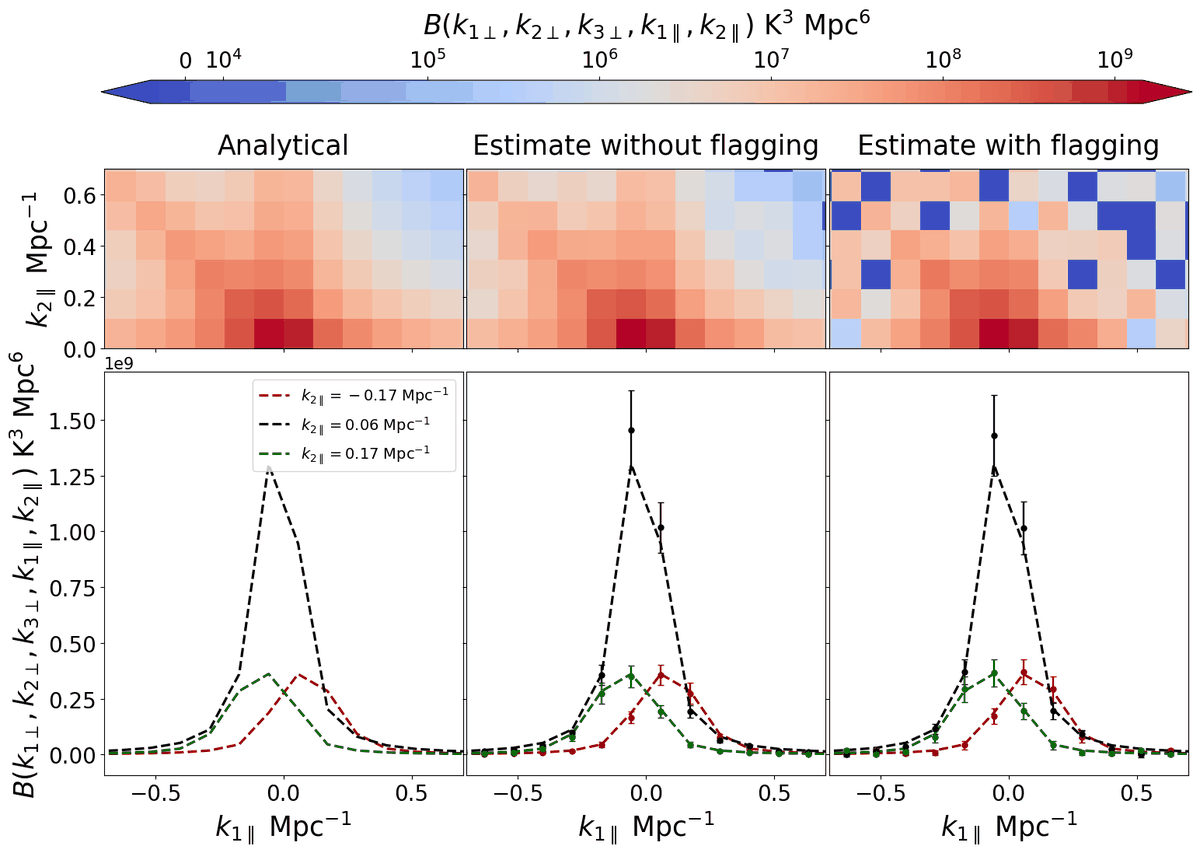
What it delivers. A fast, FFT-accelerated estimator that measures the multi-frequency angular bispectrum (MABS) and the 3D 21-cm bispectrum directly from gridded visibilities, for every triangle configuration. On simulated MWA observations (30.72 MHz of bandwidth centred on 154.25 MHz), it recovers the input bispectrum for k1 from about 0.003 to 1.26 Mpc−1 to within 20%, even with the real data's flagged channels. The differences are consistent with statistical fluctuations.

Why it matters. It makes the 21-cm bispectrum something that can actually be measured from interferometer data, and it is the measurement tool behind our MWA analysis at z = 8.2.

Three-panel comparison of the cylindrical 21-cm bispectrum: the analytical prediction, the estimate without flagging, and the estimate with flagging. Colour maps on top and line plots with error bars below show the estimates closely matching the prediction.
Figure 4 of the paperThe cylindrical bispectrum predicted analytically (left) and recovered from simulated MWA visibilities without (middle) and with (right) the real data's flagged channels.

21-cm cosmology

A Visibility-based Angular Bispectrum Estimator for Radio-interferometric Data

Sukhdeep Singh Gill, Somnath Bharadwaj, Sk. Saiyad Ali, Khandakar Md Asif Elahi

The Astrophysical Journal 979, 25 (2025)

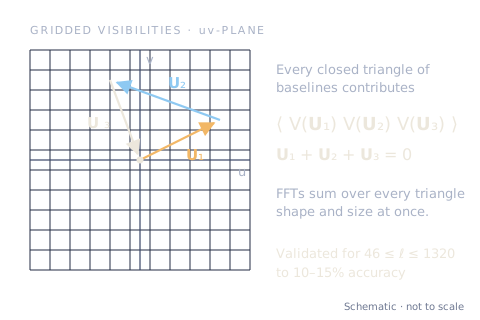
What it delivers. An estimator for the angular bispectrum that works directly on gridded visibilities from a single frequency channel, using FFTs to include every triangle shape and size. On simulated MWA data at 154.25 MHz, it recovers the angular bispectrum to 10–15% accuracy across 46 ≤ ℓ ≤ 1320.

Why it matters. Working with the visibilities that an interferometer actually records is the practical route to the bispectrum in radio data. This paper laid that groundwork, and AMBER then extended it across frequency.

Schematic of the uv-plane with three baseline vectors U1, U2 and U3 placed head to tail to form a closed triangle, next to the product of the three visibilities that the estimator averages.
SchematicThe estimator multiplies the visibilities at three baselines that close into a triangle, and averages over all such triangles.

Galaxy surveys

Brisk estimator for the angular multipoles of the redshift space bispectrum

Sukhdeep Singh Gill, Somnath Bharadwaj

Physical Review D 111, 043507 (2025)

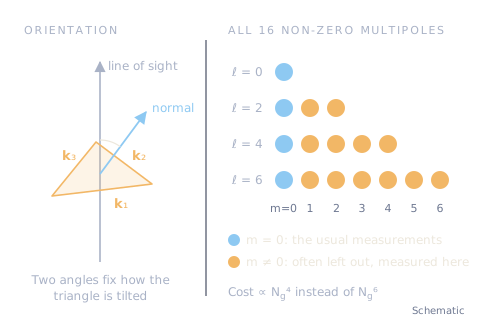
What it delivers. A fast estimator for all the angular multipoles of the redshift-space bispectrum, Bmℓ(k1, μ, t), including the m ≠ 0 terms that are usually left out. On a grid of Ng3 cells, FFTs cut the cost from order Ng6 to Ng4. On a test field with a known answer, it recovers all 16 non-zero multipoles up to ℓ = 6 and m = 6.

Why it matters. The m ≠ 0 multipoles can add substantial information beyond the usual m = 0 terms. The estimator is ready for galaxy surveys such as DESI, Euclid and LSST, and for future 21-cm maps.

Left: a triangle of wave vectors tilted relative to the line of sight. Right: the 16 non-zero multipoles arranged by l from 0 to 6 and m from 0 to l, with the m equals 0 column marked as the usual measurements and the rest as the terms this estimator adds.
SchematicHow a triangle is tilted relative to the line of sight is captured by the multipoles. BARBIE measures all 16, not just the m = 0 column.

2024

Galaxy surveys

The size and shape dependence of the SDSS galaxy bispectrum

Anindita Nandi, Sukhdeep Singh Gill, Debanjan Sarkar, Abinash Kumar Shaw, Biswajit Pandey, Somnath Bharadwaj

New Astronomy 113, 102292 (2024)

What it delivers. Measures the bispectrum of galaxies in the SDSS DR17 main galaxy sample across triangle sizes and shapes, using a volume-limited region around z ≈ 0.09, and compares it with mock catalogues built with different galaxy bias.

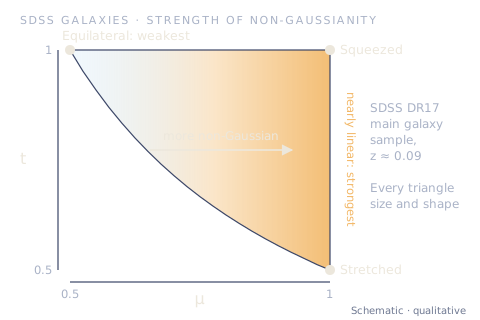
Why it matters. On these scales the galaxy distribution is non-linear and strongly non-Gaussian, least for equilateral triangles and most for nearly linear ones. Mocks with a linear bias of about 1.2 match the data best, so a simple bias model works for this sample. This sets up parameter estimation with higher multipoles.

The plane of triangle shapes shaded from pale at the equilateral corner to bright amber along the edge of nearly linear triangles, showing that non-Gaussianity grows toward linear triangles.
SchematicThe main finding across triangle shapes: non-Gaussianity is weakest for equilateral triangles and grows toward nearly linear ones.

2023

21-cm cosmology

The monopole and quadrupole moments of the epoch of reionization (EoR) 21-cm bispectrum

Sukhdeep Singh Gill, Suman Pramanick, Somnath Bharadwaj, Abinash Kumar Shaw, Suman Majumdar

Monthly Notices of the Royal Astronomical Society 527, 1135–1140 (2023)

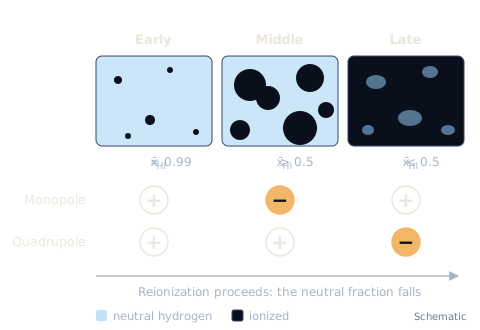
What it delivers. Uses simulations of reionization to follow the monopole and quadrupole of the 21-cm bispectrum for squeezed and stretched triangles, at k = 0.29 and 0.56 Mpc−1, as the Universe becomes ionized.

Why it matters. The signs of the two moments trace the changing topology of reionization. The monopole turns negative once distinct ionized bubbles appear. Later both flip, as the picture inverts to neutral islands in an ionized Universe, and the negative quadrupole shows that those islands survive mainly in under-dense regions. The quadrupole adds information that the monopole alone cannot give.

Three stages of reionization: early, with a few small ionized bubbles, where monopole and quadrupole are both positive; middle, with large bubbles, where the monopole is negative and the quadrupole positive; late, with neutral islands in an ionized background, where the monopole is positive and the quadrupole negative.
SchematicHow the signs of the monopole and quadrupole change as reionization proceeds.

2021

Theory & methods

A fast estimator for quantifying the shape dependence of the 3D bispectrum

Abinash Kumar Shaw, Somnath Bharadwaj, Debanjan Sarkar, Arindam Mazumdar, Sukhdeep Singh, Suman Majumdar

Journal of Cosmology and Astroparticle Physics 12 (2021) 024

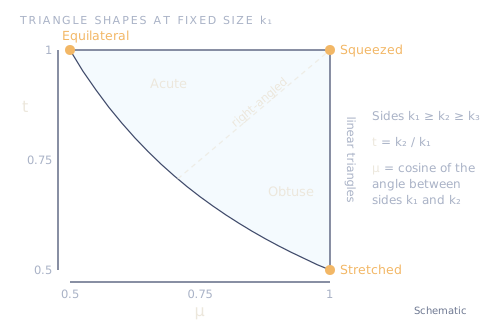
What it delivers. A fast FFT-based estimator for the binned 3D bispectrum that separates a triangle's size (k1) from its shape (μ, t), so the full shape dependence can be mapped. Its cost scales as Ng3 log Ng3, close to a single FFT of the grid, and it agrees with analytical predictions to within 10% across much of the shape plane, including with linear redshift-space distortions.

Why it matters. It made it practical to study the bispectrum as a function of triangle shape, and it became the starting point for the shape-dependent analyses that followed.

The plane of triangle shapes with axes mu and t, both from 0.5 to 1. Equilateral triangles sit at the top-left corner, squeezed at the top-right, stretched at the bottom-right; a dashed line of right-angled triangles separates acute from obtuse shapes.
SchematicEvery triangle shape is a point in the (μ, t) plane, so the bispectrum can be mapped shape by shape at each size k1.

Collaboration papers

SKA Observatory science

Large-collaboration preprints on 21-cm science with the SKA Observatory, to which I contributed.